Nonstick cookware: what actually destroys the coating

Nonstick pans have a reputation for not lasting, and in practice the ones that fail early nearly always fail for the same handful of reasons. Scratching is the famous one and not actually the most common. Heat is, and it does its damage invisibly.
Empty pans overheat within seconds
Food and liquid absorb heat and keep the pan surface at a moderate temperature. An empty pan on a high burner climbs far past that very quickly.
Preheating a nonstick pan empty on high is the single most damaging habit, and it is extremely common. Heat it gently, and add oil or food early.
High heat is not what nonstick is for
The coating is optimised for low and medium heat, which is where nonstick actually matters. Searing at high temperature is a job for stainless or cast iron.
Using the right pan for high-heat work extends the life of the nonstick one considerably, and produces a better sear.
Thermal shock warps the base
Running a hot pan under cold water contracts the base rapidly and unevenly. A warped base no longer sits flat, heats unevenly and, on induction, may not work properly at all.
Let a pan cool on the hob before it goes anywhere near water. This also protects the coating from the same shock.
Metal utensils cut; everything else does not
A metal edge under pressure cuts the coating, and once cut it lifts progressively. Silicone, nylon and wood do not.
This is the well-known rule and it is worth following, but it accounts for less early failure than heat does.
Abrasive cleaning finishes what a scratch starts
Steel wool and harsh scouring pads remove coating directly. A soak in warm soapy water releases almost anything a nonstick pan can hold onto.
If food is stuck to a nonstick pan, that is usually a sign it was too hot rather than a sign it needs scrubbing harder.
Stacking scratches the inside
Pans stacked directly inside each other grind their bases against the coating below every time they are moved.
A cloth, a paper plate or a purpose-made protector between them prevents it entirely, and costs nothing.
Cookware and utensils
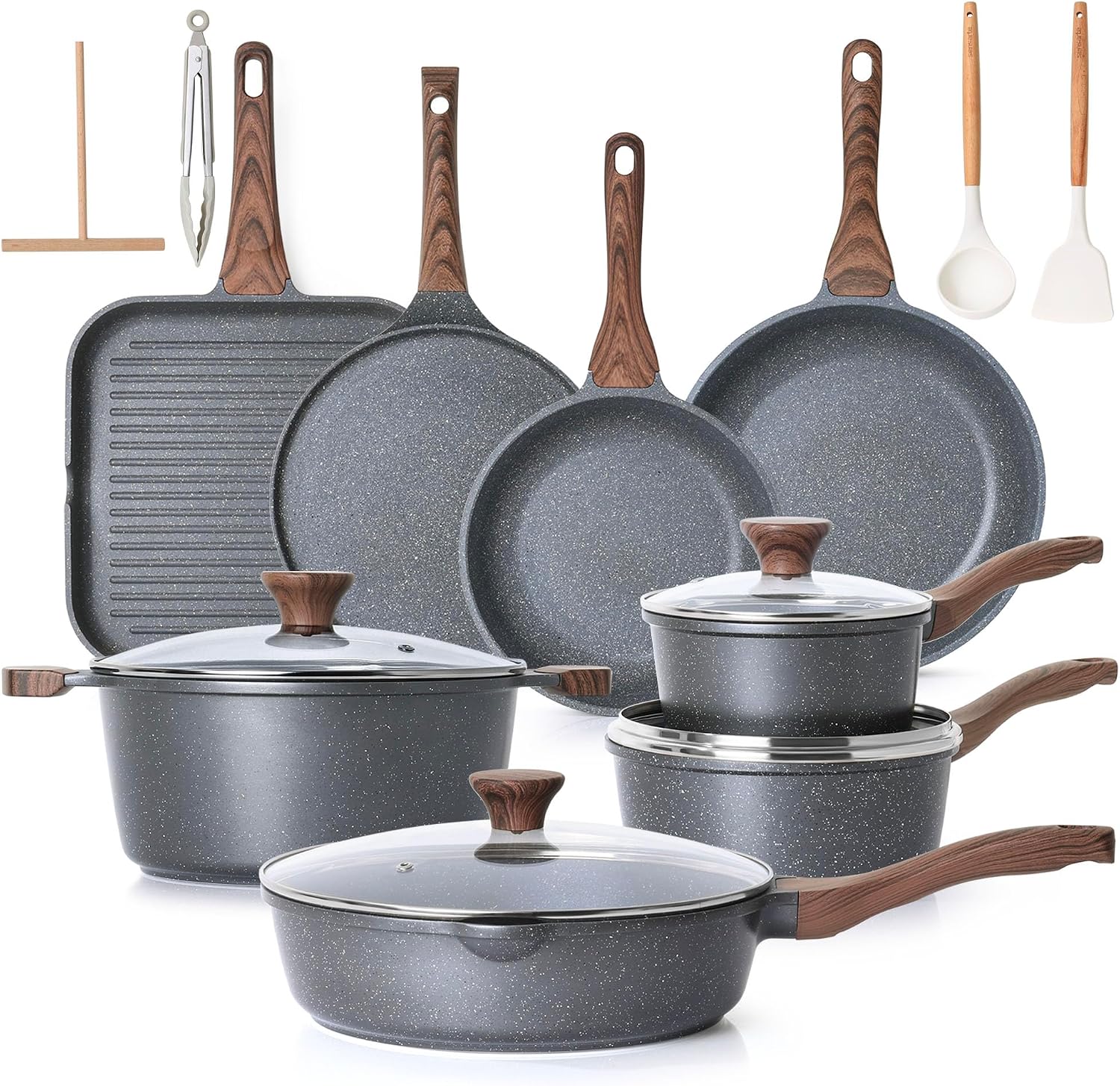
The granite nonstick set on this shelf pairs naturally with the silicone utensils, which is what keeps a coating intact. On our own shelf that range currently runs from $199.99 for the SENSARTE 23-Piece Nonstick Granite Cookware Set – Induction, Gray up to $199.99 for the SENSARTE 23-Piece Nonstick Granite Cookware Set – Induction, Gray.
Everything listed here is part of Cookware Sets, which holds 1 product just now. These are the charged figures, and nothing is added between here and payment.
Related reading
Two other pieces on this site cover ground next to this one. Silicone stains because it is slightly permeable to oil, and the pigments in question travel in oil. And on a related note, both plastic and wood can be used safely, and the deciding factors are usually knife wear and how you wash them.
- Why light silicone stains and whether it matters
- Cutting boards: plastic, wood and what antimicrobial means
Mistakes that shorten a set fastest
Preheating empty is the first and it is nearly universal, because people apply the habit they learned with stainless. Nonstick does not need it and is damaged by it.
Washing while still hot is the second. The thermal shock warps the base, and a warped base rocks on the hob, heats unevenly and on induction may lose contact altogether.
When a nonstick pan should be retired
Once the coating is flaking rather than merely scratched, the pan has reached the end of its life. Food will stick to the exposed areas and the flakes are ending up in the food.
A pan that has warped enough to rock on a flat surface is also finished for practical purposes, because it will never heat evenly again. Both are honest end points, and both are cheaper to accept than to cook around.
Choosing pan sizes that actually get used
Large sets tempt with piece count, and in most kitchens two or three sizes do nearly all the work. A small pan for eggs, a medium for everyday, and one large enough for a family portion covers most cooking.
The rest tends to live in a cupboard, and pans stored stacked without protection get scratched by each other. Buying the sizes you will use, and storing them properly, does more for a set than buying more pieces.
Induction, gas and what the base has to do
Induction requires a ferrous base and good flatness, so a warped pan may heat unevenly or stop working altogether. Gas is more forgiving of a slightly uneven base but concentrates heat in a ring.
Either way, the base is the part that determines cooking performance more than the coating does. A heavy, flat, well-bonded base is what stops hot spots, and hot spots are what damage coatings from the inside.
How to make a set last
Never heat it empty, keep it to low and medium heat, let it cool before washing, use silicone or wood, soak rather than scour, and put something between stacked pans. Those six habits are the difference between two years and ten.
We supply from Glendale, CA: $6.50 carriage, free over $59, 30 days to return anything unused. Trade questions go to [email protected].