Reading a silicone heat rating properly

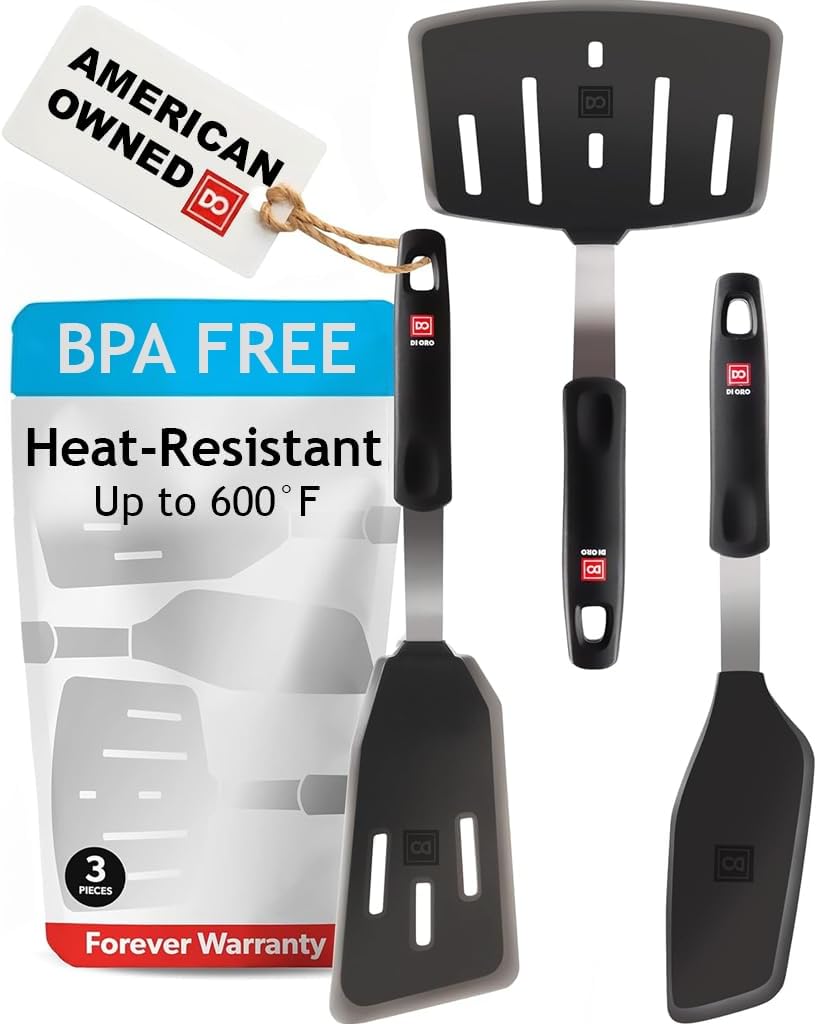
Silicone utensils carry a printed temperature rating, and it is one of the most commonly misread numbers in a kitchen. It describes the point at which sustained contact begins to affect the material — not a working target, and not a guarantee against every situation a hot pan can produce.
Sustained contact is the condition being described
A rating assumes the material is held at that temperature for a period. Brief contact with something hotter is usually survivable; resting against it is not.
This is why a spatula left leaning in a hot pan degrades while the same spatula used constantly in the same pan does not.
A pan surface is hotter than the food in it
Oil in a hot pan can exceed the food temperature considerably, and the metal of the pan more so. The relevant temperature is the surface the utensil touches, not the contents.
That is the practical reason to keep a utensil moving and to take it out of the pan when you are not using it.
Damage looks like softening, stickiness or a smell
Overheated silicone becomes tacky, may deform slightly, and can develop a faint smell. Discolouration alone is usually staining rather than heat damage.
A utensil that has gone sticky is not recoverable and should be replaced, because the surface will pick up residue from that point on.
The steel core is what keeps the shape
Better silicone utensils are moulded over a steel core, which is why they stay rigid at temperature and do not fold under a heavy item.
Solid silicone without a core is fine for scraping a bowl and less good for lifting anything with weight. The listing usually tells you which it is.
Staining is not degradation
Tomato, turmeric and paprika will colour light silicone. It is purely cosmetic, does not affect performance and does not indicate any heat damage.
A hot dishwasher cycle or bicarbonate paste removes most of it, and darker utensils sidestep the issue.
Do not use it under a broiler or on an open flame
Direct radiant heat and flame are a different proposition from pan contact, and they exceed what any silicone utensil is rated for.
For those jobs use metal, and keep the silicone for the pan.
Ratings on our listings
The silicone lines here carry their own stated ratings, and the ones built over a steel core are identified as such. On our own shelf that range currently runs from $5.99 for the OYV 12-Inch Silicone Whisk, Dishwasher Safe & Non-Scratch, Gray up to $14.99 for the BUNDLEPRO 2-Pack Silicone Solid Turner Spatulas – Non-Stick, High-Heat Khaki.
Everything listed here is part of Cooking Utensils, which holds 12 products just now. These are the charged figures, and nothing is added between here and payment.
- OYV 12-Inch Silicone Whisk, Dishwasher Safe & Non-Scratch, Gray — $5.99
- VITEVER 3-Pack Silicone Spoonula Set for Nonstick Cookware – Black, Gray, Khaki — $7.99
- OYV Premium Blue Silicone Whisk Set – 4 Heat-Resistant, Non-Scratch Whisks — $9.99
- Anaeat Non-Stick Silicone Locking Tongs Set of 3 – 7", 9", 12" Black Stainless Steel — $11.99
- Bianest 9-Piece Black Silicone Spatula Set for Cooking & Baking — $11.99
- BUNDLEPRO 2-Pack Silicone Solid Turner Spatulas – Non-Stick, High-Heat Khaki — $14.99
Related reading
Two other pieces on this site cover ground next to this one. Most nonstick pans are killed by heat rather than by scratches, which is the opposite of what people expect. And on a related note, silicone stains because it is slightly permeable to oil, and the pigments in question travel in oil.
- Nonstick cookware: what actually destroys the coating
- Why light silicone stains and whether it matters
Where ratings get exceeded without anyone noticing
An empty pan preheating on a high burner is the usual place. The surface climbs far past cooking temperature within a minute, and a utensil left in it is sitting against metal well beyond its rating.
The other is the rim of a pan on a gas hob, where flame licks up the side. That edge is considerably hotter than the cooking surface, and it is exactly where a utensil rests when it is left in the pan.
What to do with a damaged utensil
Silicone that has gone tacky or deformed should be taken out of service. The surface will now hold residue that cannot be washed off, and it will keep picking up more.
It is not a safety emergency, but it is a hygiene one, and these are inexpensive enough that keeping a degraded tool in a professional kitchen is a false economy. Replace it and keep the heat habits that caused it in mind.
Using them well
Treat the rating as a ceiling for sustained contact, keep the utensil moving, take it out of the pan when it is not in use, keep it away from flame and the broiler, and replace anything that has gone tacky.
We supply from Glendale, CA: $6.50 carriage, free over $59, 30 days to return anything unused. Trade questions go to [email protected].