Whisks: balloon, flat and the one most people should own

A whisk seems like a single tool with cosmetic variations, and the shapes are genuinely functional. Each is designed around a different task — incorporating air, working a flat pan, or breaking up lumps — and using the wrong one makes a job harder than it needs to be.
The balloon whisk incorporates air
A wide, rounded head with many thin wires moves a lot of air into whatever it is working, which is what you want for egg whites, cream and anything you are trying to aerate.
It is the least useful shape in a flat-bottomed pan, because the round head only touches a small area of the base.
The flat whisk works a pan
A flat whisk lies against the bottom of the pan, so it reaches the whole surface where a sauce is thickening and catching. For gravy and roux it is substantially better than a balloon.
It is also easier to get into the corner where a pan side meets the base, which is exactly where things burn.
The ball whisk handles lumps
Individual wires ending in small balls move independently, which breaks up lumps in batters effectively and is easy to clean because there is no enclosed head.
It aerates less well than a balloon, so it is a specialist rather than a first purchase.
Wire count changes the feel
More, thinner wires whip faster and with less effort but are more delicate. Fewer, thicker wires are sturdier and better for heavy batters.
For general use a medium wire count is the sensible compromise, and it is what most kitchen whisks are.
Silicone-coated whisks protect coated pans
A bare metal whisk will score a nonstick pan, and sauces are exactly the thing people make in nonstick. A silicone-coated whisk avoids that entirely.
It also stops the metallic noise against a pan, which is a small but real quality-of-life difference.
Cleaning: the head is where things hide
Egg and batter dry hard inside a whisk head and are difficult to remove once set. Rinsing immediately after use avoids nearly all of it.
Whisks with a sealed head where the wires meet the handle are harder to clean thoroughly. Open designs dry faster and more reliably.
Whisks we carry
The whisks on this shelf are silicone over steel, which suits the coated pans most sauces are actually made in. On our own shelf that range currently runs from $9.98 for the Cooking Tongs Set of 2: Stainless Steel with Black Silicone Tips, 7 & 9 Inch up to $29.99 for the Home Hero 41-Piece Stainless Steel Kitchen Utensil Set with Heat-Resistant Silicone.
Everything listed here is part of Kitchen Utensils, which holds 6 products just now. These are the charged figures, and nothing is added between here and payment.
- Cooking Tongs Set of 2: Stainless Steel with Black Silicone Tips, 7 & 9 Inch — $9.98
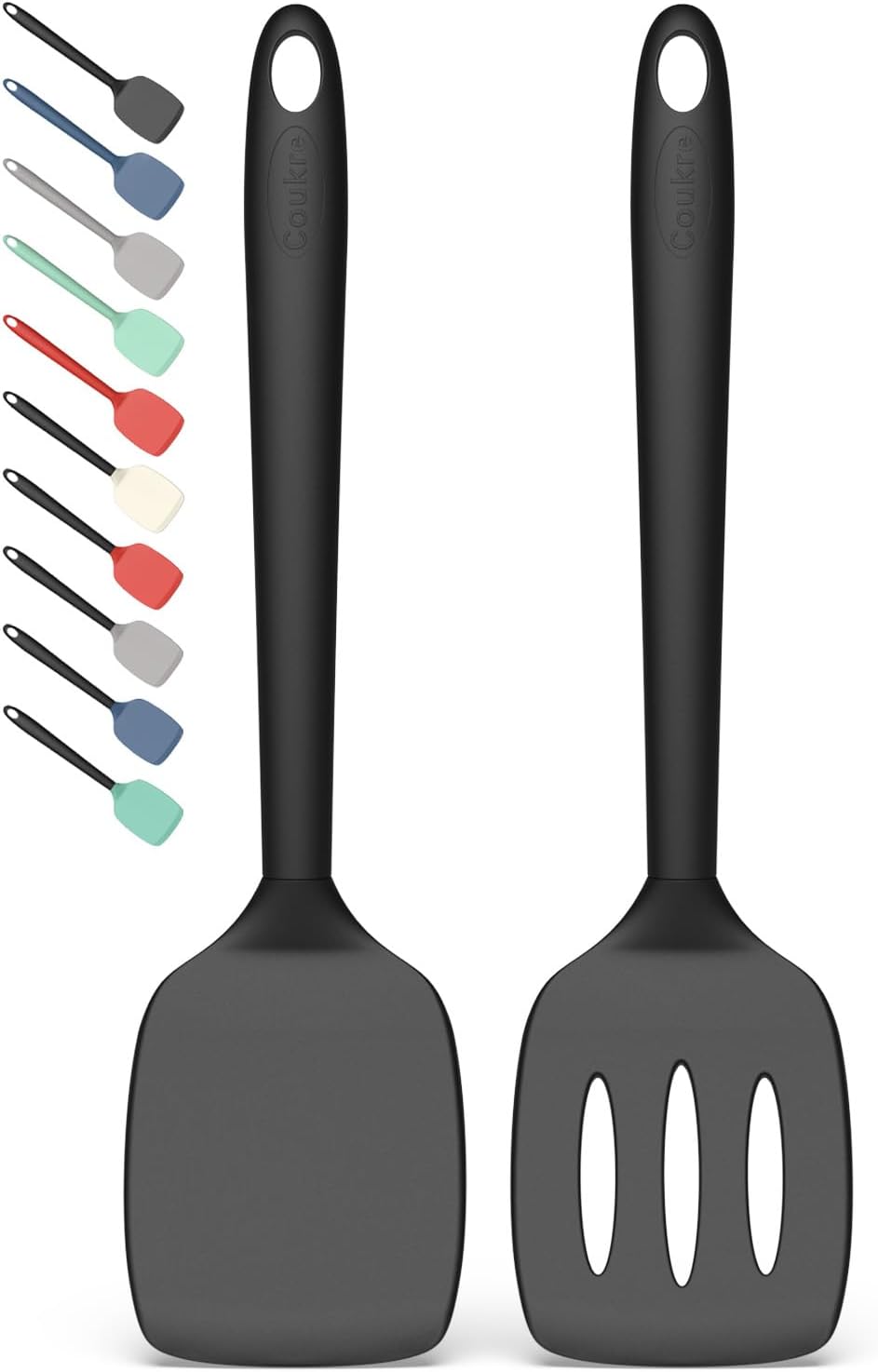
- Coukre 2-Pack PureBlack Silicone Spatulas for Cooking & Flipping, Heat Resistant — $9.99
- Beijiyi 3-Pack Silicone Spatula & Turner Set – Heat Resistant, BPA-Free — $15.28
- Miusco 5-Piece Non-Stick Silicone & Acacia Wood Utensil Set, Midnight Blue — $19.99
- RFSCDI White Silicone & Stainless Steel 6-Piece Cooking Utensil Set — $27.99
- Home Hero 41-Piece Stainless Steel Kitchen Utensil Set with Heat-Resistant Silicone — $29.99
Related reading
Two other pieces on this site cover ground next to this one. Equipment that works well at home fails in a busy kitchen for reasons that have little to do with quality. And on a related note, a heat rating is a ceiling for sustained contact, not a temperature the tool is designed to work at.
Technique that matters more than the whisk
Whisking from the wrist in a small circle moves very little air. A larger motion that lifts the mixture and folds air into it is what actually aerates, and it is why hand-whisked cream takes people by surprise.
Bowl shape matters too. A round-bottomed bowl lets a whisk reach everything; a flat-bottomed one leaves a ring at the edge that never gets incorporated, which is usually blamed on the whisk.
Cleaning and storage
Rinsing immediately is the whole battle. Egg and batter set hard inside a whisk head and become genuinely difficult once dry, particularly where the wires converge at the handle.
Storing a whisk hanging rather than in a drawer keeps the wires from being bent out of shape by other utensils. A distorted whisk head no longer sits evenly in a bowl and whisks noticeably less effectively.
Handle length and where the balance sits
A whisk that is too short puts your knuckles in the bowl and a whisk that is too long is tiring to control. Somewhere around a hand-and-a-half of handle suits most bowls and most people.
Balance matters as much as length. A head-heavy whisk does more of the work on the downstroke, which is what you want for cream; an evenly balanced one is easier to control in a pan of thickening sauce.
If you own one
Make it a medium balloon whisk with a silicone coating, which handles eggs, cream and most sauces. Add a flat whisk if you make gravy or roux often — that is the one that will surprise you with how much easier it makes the job.
We supply from Glendale, CA: $6.50 carriage, free over $59, 30 days to return anything unused. Trade questions go to [email protected].